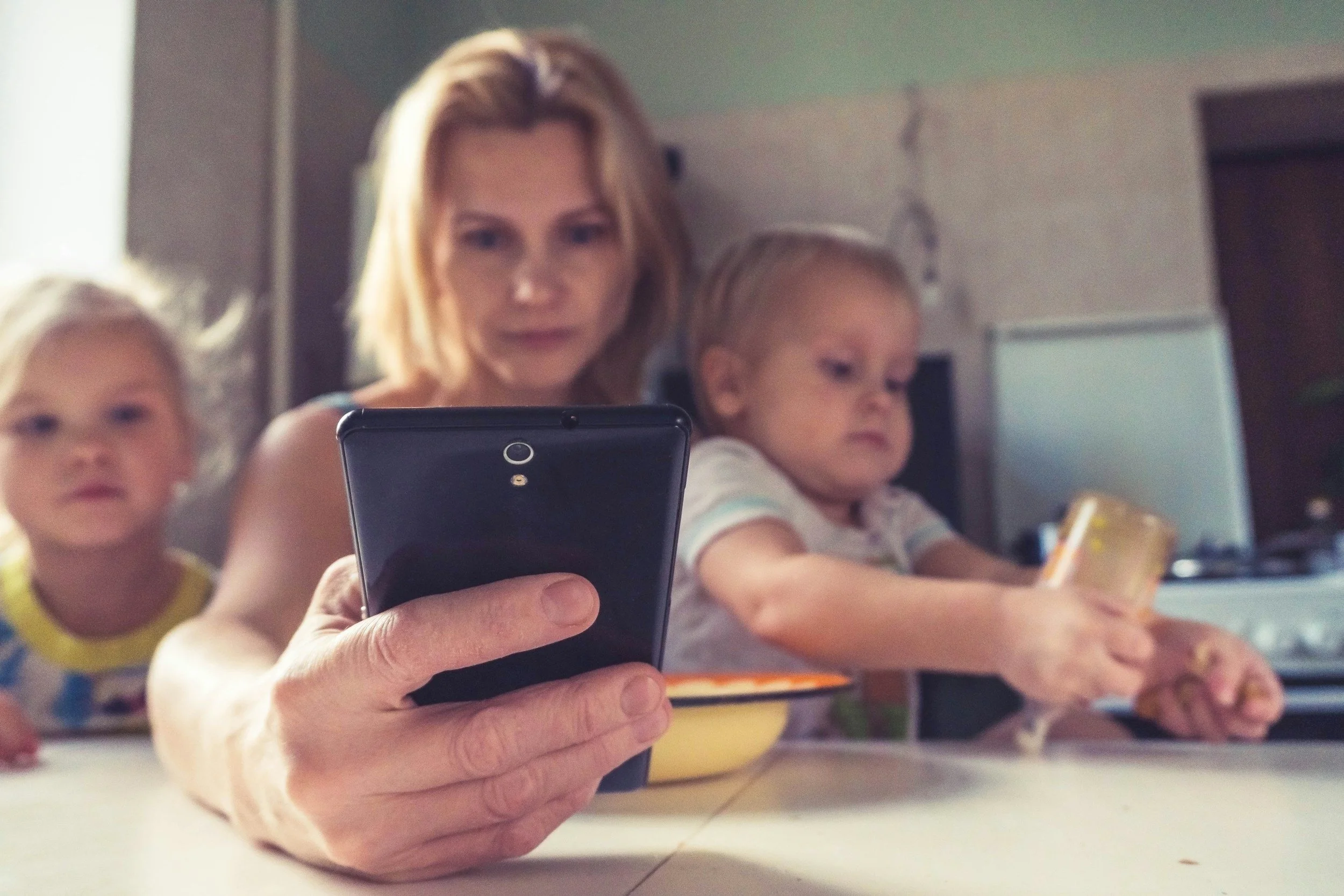
There are days when I want to put my phone down, stop watching the news, and just enjoy being a mom. I want to take my kids to the park, make dinner, listen to their stories about school, and be present for the little moments that make up our lives.
And then I see another headline.
Another story about violence. Another report about political division, international conflict, the economy, climate change, or something else that makes the future feel a little less certain. Suddenly, I'm not just thinking about what's happening today. I'm thinking about the world my children will grow up in, the things they might experience, and whether I'm doing enough to prepare them for a future I can't predict.
If you've found yourself worrying about the state of the world while trying to pack lunches, get everyone out the door, answer work emails, and keep your household running, you're not alone.
Being a mom while feeling anxious about the state of the world is emotionally exhausting. You want to protect your children, but you can't protect them from everything. You want to stay informed, but consuming the news can leave you feeling overwhelmed. You want to enjoy your life, but sometimes it feels irresponsible to relax when there is so much happening beyond your front door.
At The Bloomhouse Women's Counseling Collective in Fort Collins, Colorado, we understand that anxiety doesn't always come from something happening directly to you. Sometimes it comes from caring deeply about your children and the world they are growing up in.
And sometimes, learning to manage that anxiety starts with recognizing that you can care about the world without carrying all of it on your shoulders.
Why Are So Many Moms Feeling Anxious About the State of the World?
If it feels like there is always something new to worry about, there are reasons for that.
In its 2026 annual mental health poll, the American Psychiatric Association reported that 62% of adults felt anxious about current events, making it one of the leading sources of anxiety alongside concerns about paying bills and expenses. In a separate 2025 poll, 67% of adults reported feeling anxious about current events happening around the world, while 62% worried about keeping themselves or their families safe. (American Psychiatric Association, 2026)
For mothers, these concerns can take on another layer. We aren't just thinking about ourselves. We're thinking about our children, their safety, their emotional well-being, their education, and the kind of future they'll inherit.
A headline about violence may lead to worries about school safety. News about international conflict may make you wonder what the future holds. Economic uncertainty may leave you questioning whether your family will be financially secure. Stories about climate change may bring up fears about the environment your children will grow up in.
And because we now have access to news and social media around the clock, it's possible to encounter upsetting information before we've even gotten out of bed.
The American Psychological Association's Stress in America 2024 survey found that 77% of adults considered the future of the nation a significant source of stress. Politics, violence, the environment, and global tensions were also major stressors. (American Psychological Association, 2024)
So if you've been feeling anxious, unsettled, or emotionally depleted by current events, it doesn't automatically mean something is wrong with you. You're responding to a world that can feel unpredictable, and you're trying to navigate that uncertainty while caring for people you love more than anything.
The Unique Pressure of Being a Mom in an Uncertain World
Motherhood can change the way you experience fear.
Before having children, you might have read a troubling headline, felt upset, and moved on with your day. After having children, that same story can send your mind into a spiral of possibilities.
You might find yourself thinking about all the things that could happen to your children, even when they are safe and nothing is immediately wrong.
You may feel an urge to research every possible threat, monitor the news, or make plans for situations you hope will never happen (not me buying water-filtering Life Straws on Amazon Prime Day…just in case.). You might even feel guilty when you're enjoying yourself because a part of you thinks you should be paying attention to what's happening in the world.
This can become especially difficult when you're already managing the everyday demands of motherhood: work, school schedules, household responsibilities, relationships, and the emotional needs of your children.
Your brain has only so much capacity. When it is constantly scanning for potential threats, it can become harder to relax, sleep, concentrate, or be emotionally present.
You might notice yourself becoming more irritable with your kids, feeling distracted during family time, or struggling to enjoy moments that would normally bring you happiness.
You can love your children deeply and still feel overwhelmed by the responsibility of raising them in an uncertain world.
When Staying Informed Starts Fueling Your Anxiety
There is a difference between staying informed and feeling compelled to monitor every new development.
Maybe you open your phone to check one headline, and 30 minutes later you've read dozens of stories, watched upsetting videos, and scrolled through arguments in the comments. You feel worse than when you started, but you keep scrolling because you want to understand what's happening, and also because the addictive nature of social media is designed to keep you seeking for more.
This cycle is understandable. When something feels threatening or uncertain, gathering information can create a temporary sense of control. We tell ourselves that if we know enough, we'll feel prepared.
But constant exposure to distressing news can have the opposite effect.
The American Psychological Association has described how media overload can contribute to stress and how setting boundaries around news consumption can help people protect their mental health. (Huff, 2022)
If you notice that checking the news leaves you feeling panicked, angry, helpless, or unable to focus on your day, it may be time to change your relationship with it.
That doesn't mean ignoring important events or pretending everything is fine. It means recognizing that you don't have to consume every update to be an informed, engaged person.
Try choosing one or two reliable sources and checking them at specific times rather than reaching for your phone throughout the day. Consider turning off breaking-news notifications, limiting/unfollowing social media accounts that leave you feeling activated, and avoiding distressing content right before bed.
Pay attention to how you feel afterward. If your anxiety increases every time you check the news, that is useful information about what you need.
How to Manage World Events Anxiety While Raising Children
You cannot control everything happening in the world, but you can take steps to help yourself feel more grounded in your daily life.
1. Separate what you can control from what you cannot
When you're anxious, your mind may try to solve problems that are far beyond your individual control. You may spend hours worrying about political decisions, international conflict, economic instability, climate changes, or what might happen years from now.
Instead of trying to resolve every uncertainty, gently bring your attention back to what is within your influence.
You can decide how you consume news. You can vote, volunteer, donate, participate in your community, or support causes that matter to you. You can teach your children compassion, encourage curiosity, and model how to respond thoughtfully when something feels unfair or frightening.
You can also take care of yourself, nurture your relationships, and create a sense of connection and stability at home.
These actions won't fix every problem in the world. They can, however, help you reconnect with your own agency rather than remaining stuck in helplessness.
2. Give your nervous system opportunities to settle
When you're repeatedly exposed to upsetting information, your body may respond as though danger is immediately present, even when you're physically safe in your home.
You might notice a racing heart, muscle tension, shallow breathing, irritability, or difficulty concentrating.
The Centers for Disease Control and Prevention explains that stress is a normal response to challenging situations, but prolonged stress can negatively affect health. Its guidance on managing stress emphasizes the importance of everyday coping strategies and seeking additional support when needed.
When you notice yourself becoming activated, try slowing your breathing, taking a short walk, stretching, or stepping outside for a few minutes. Put your phone down and pay attention to what is happening around you right now.
You don't have to force yourself to feel positive. The goal is simply to help your body recognize the difference between reading about something frightening and experiencing immediate danger yourself.
3. Let yourself enjoy your life without feeling guilty
This can be a surprisingly difficult one for moms.
You might be laughing with your kids, enjoying a beautiful Colorado afternoon, or looking forward to a family vacation when a thought creeps in: How can I enjoy myself when so many people are suffering?
But your happiness is not a betrayal of your values.
You can care about people experiencing hardship and still enjoy dinner with your family. You can acknowledge frightening realities and still laugh at your child's ridiculous joke. You can be concerned about the future and still appreciate the life you have today.
In fact, making room for connection, play, rest, and joy can help you sustain your capacity to care over time. You do not have to remain emotionally distressed to prove that you care.
4. Think about how you want your children to experience the world
Children often pick up on our emotional cues, even when we think we're hiding our worries. They may hear the news in the background, notice changes in our mood, or overhear conversations about frightening events.
The American Academy of Child and Adolescent Psychiatry explains that repeated exposure to distressing news can contribute to children's fears and anxiety. It recommends that parents pay attention to what children see and hear and help them process upsetting information in an age-appropriate way. (AACAP, 2025)
You don't need to shield your children from every difficult reality. Instead, consider what they are developmentally ready to understand, limit their exposure to graphic or repetitive news coverage, and leave room for questions.
If your child asks about something frightening, you can acknowledge that it is upsetting without giving them more detail than they need. Offer reassurance that the adults in their life are working to keep them safe, while being honest about what you know and what you don't know.
And remember that your children don't need you to be perfectly calm all the time. They benefit from seeing you notice your feelings, use healthy coping strategies, and reach out for support when you need it.
When Should You Consider Therapy for Anxiety About the World?
It is possible to feel worried about current events without having an anxiety disorder. Concern about real problems is not automatically pathological, and therapy isn't about convincing you that your concerns are unreasonable.
But if anxiety about the state of the world or current events is beginning to interfere with your daily life, relationships, sleep, or ability to enjoy motherhood, it may be time to seek support.
Consider reaching out to a therapist if you find yourself constantly anticipating something terrible happening, struggling to stop researching frightening possibilities, feeling panicked when you are away from your children, or having trouble concentrating because your thoughts keep returning to current events.
You might also notice that you're more irritable with your family, emotionally withdrawn, sleeping poorly, or feeling a persistent sense of dread. Perhaps you know intellectually that you cannot control everything, but you still feel compelled to try.
These patterns can be especially exhausting when combined with existing anxiety, perfectionism, trauma, or an insecure attachment style.
You don't have to wait until anxiety becomes unbearable to seek therapy. A therapist can help you understand what is fueling your worry, develop tools to manage uncertainty, and find ways to stay engaged with the world without feeling consumed by it.
How Anxiety Therapy in Fort Collins Can Help
At The Bloomhouse Women's Counseling Collective, we work with women and mothers who are navigating anxiety, chronic stress, perfectionism, trauma, relationship challenges, and the emotional demands of motherhood.
Our approach to therapy in Fort Collins is trauma-informed, attachment-focused, and collaborative. Rather than simply telling you to worry less, we work to understand what is happening beneath the anxiety and help you develop strategies that fit your life.
Depending on your needs, therapy may include learning to recognize anxiety triggers, practicing nervous system regulation, challenging catastrophic thinking, developing healthier boundaries with news and social media, and exploring past experiences that may make uncertainty especially difficult to tolerate.
For some women, anxiety about the world connects to a deeper fear of not being able to protect the people they love. For others, it brings up earlier experiences of instability, loss, or feeling unsafe. Understanding those patterns can help you respond to worry differently instead of feeling pulled into the same cycle again and again.
The Bloomhouse Women's Counseling Collective offers in-person counseling in Fort Collins, Colorado, as well as secure virtual therapy throughout Colorado. We support women across life stages, including mothers navigating anxiety, motherhood stress, attachment concerns, and major life transitions.
If you're looking for a therapist in Fort Collins or Northern Colorado who understands the emotional complexity of motherhood, you don't have to figure everything out on your own. We offer a free 15-minute consultation to help you explore your needs and find a therapist who may be a good fit.
Visit The Bloomhouse Women's Counseling Collective to learn more about our services.
You Can Care About the World Without Carrying It All
I don't think the answer to anxiety about the world is to stop caring. Our concern for other people, our communities, and our children's futures is part of what makes us human.
But caring and carrying are two different things.
You can care deeply about what is happening without reading every headline. You can take meaningful action without being responsible for fixing everything. You can prepare your children for life without spending every day imagining the worst things that might happen to them.
And you can be a thoughtful, engaged mother while still giving yourself permission to enjoy the ordinary moments of your life.
The world may remain uncertain. You may not always have answers about what comes next. But you can learn to recognize when anxiety is pulling you away from the present, find ways to reconnect with what matters to you, and seek support when the weight feels too heavy.
Your children don't need you to predict every danger or eliminate every uncertainty. They need a parent who is supported, connected, and able to return to the present—even when the world feels overwhelming.
And you deserve that support, too.
References
American Academy of Child and Adolescent Psychiatry. (2025). Children and the news (Facts for Families No. 67). https://www.aacap.org/AACAP/Families_and_Youth/Facts_for_Families/FFF-Guide/Children-And-The-News-067.aspx
American Psychiatric Association. (2026, May 12). Annual mental health poll finds Americans anxious about current events, personal finances and emerging technology. https://www.psychiatry.org/News-room/News-Releases/2026-Annual-Mental-Health-Poll
American Psychological Association. (2024). Stress in America 2024: A nation in political turmoil. https://www.apa.org/pubs/reports/stress-in-america/2024
Centers for Disease Control and Prevention. (2026, May 12). Managing stress. https://www.cdc.gov/mental-health/living-with/
Huff, C. (2022, November 1). Media overload is hurting our mental health. Here are ways to manage headline stress. Monitor on Psychology, 53(8). American Psychological Association. https://www.apa.org/monitor/2022/11/strain-media-overload
About the Author

Hannah Dorsher, MA, LPC, CAT, NCC, EMDR is a therapist and co-founder of The Bloomhouse Women's Counseling Collective in Fort Collins, Colorado. She specializes in women's mental health, anxiety, attachment and relationship challenges, motherhood stress, perfectionism, and trauma. Hannah's approach is rooted in attachment theory, trauma-informed care, and nervous system regulation, with a compassionate, down-to-earth style that helps clients feel safe, understood, and empowered. Schedule with her here (CO residents only).